
 People of Europe, Guard Your Precious Values
 The Art in Liquidation
 Art and Crisis - Facing Bureaucrat (video)
 VQ Bourse - The Value is Here
 VQ - Art of Fortune and Economy of Risk
 VQ - Golden Card
 That Which Changes
 Who is Guarding the Guardians?
 Social Engine
 Dictionary of Primal Behaviour
 Lapsus Memoriae
 Kumova Sekira
 Omnigenus
 Urtica Medicamentum Est
 Social Engine - The Hybrid Source Book
 "Value Quest Bourse: Value Is Here?" by Tijana Jovanović Petrović
 "How to Survive in An Advantageous Dystopia?" by Violeta Vojvodić Balaž
 "The easthetic pleasure of communication" by Graham Pullin
 "Soft Power and NATO Branding" talk by Violeta Vojvodić
|
Social EngineInteractive Database
|
- Photo doc
- + more
 go to -> Book
“Social Engine” Article in
“Danas”
daily newspaper [serbian only]-
Art and Society
An interactive database of socio-cultural patterns
-
Keywords / Tags
- Database art,
- Society,
- Socio-cultural patterns,
- Discourse,
- Social awareness,
- Control,
- Flag,
- Cognitive structure,
- Communication,
- Information,
- Soft power,
- Social system
Art-Bio:
Solo Exhibition
- 2005
- Innsbruck, Austria, within the framework of “Private Investigations,” Künstlerhaus Büchsenhausen
Festivals and Group Exhibitions
- 2008
- Lüneburg, Germany, “Moiré”, Kunstraum der Leuphana Universität Lüneburg
- 2007
- Čačak, Serbia, 24th Memorial Nadežda Petrović
- Rio de Janeiro, Brazil, “FILE RIO 2007” International Festival of Electronic Language
- Beograd, Srbija, “PRODOR U REALNOST: Ukidanje javnog prostora,” Salon Muzeja savremene umetnosti Beograd
- 2006
- Oklahoma City, USA, Upgrade! International: Oklahoma City: DIY
- Saint Étienne, France, Biennale Internationale Design
- Sao Paolo, Brazil, “FILE 2006” International Festival of Electronic
- Belgrade, SCG, “Disappearing of the public space,” Salon of the Museum of Contemporary Art Belgrade
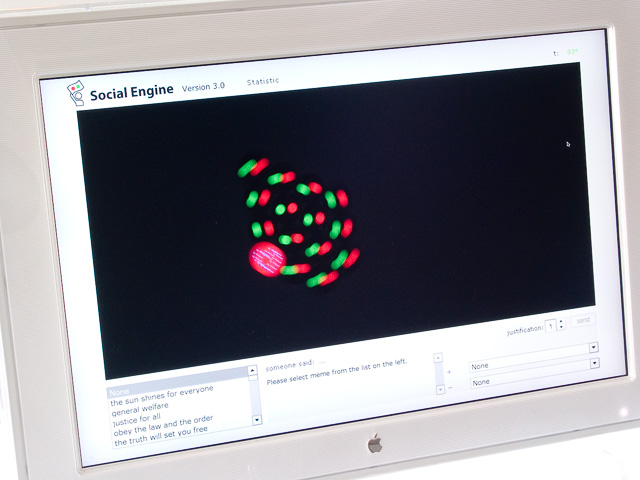
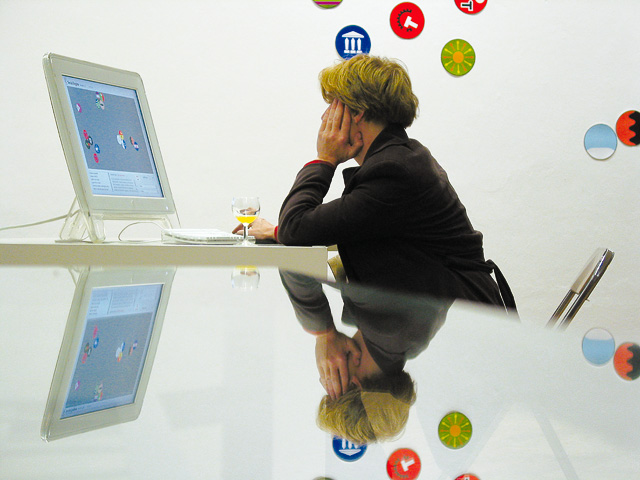
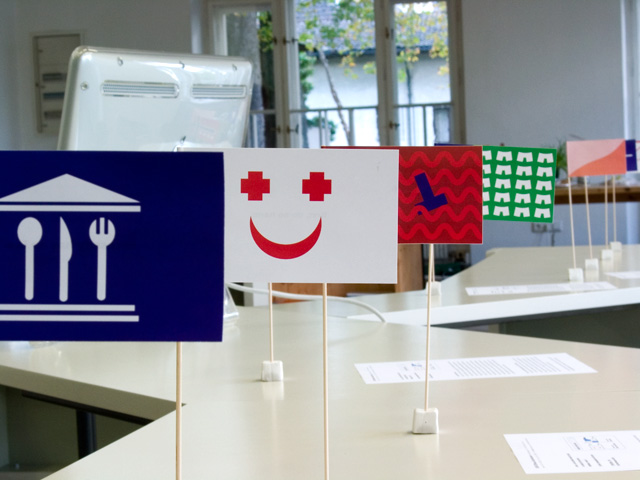


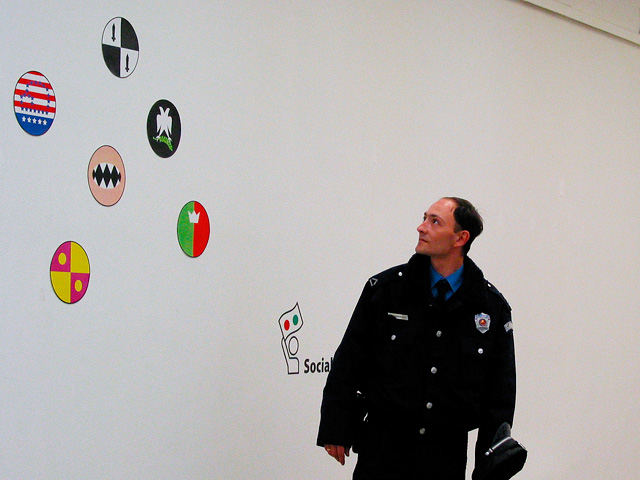
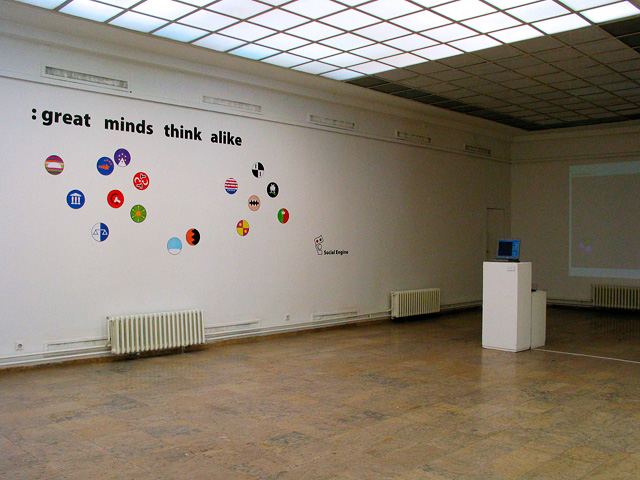
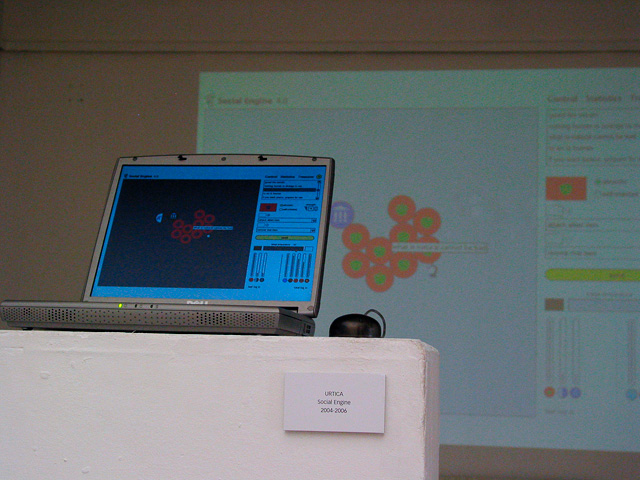
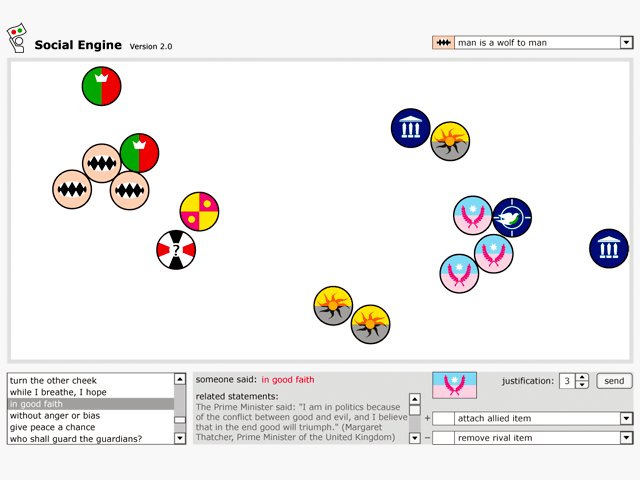
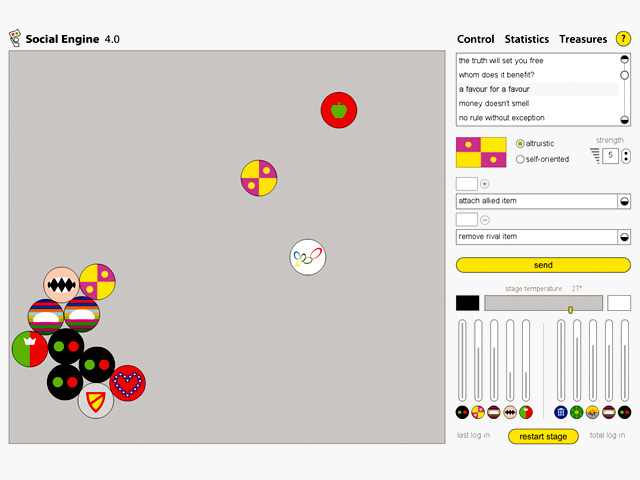
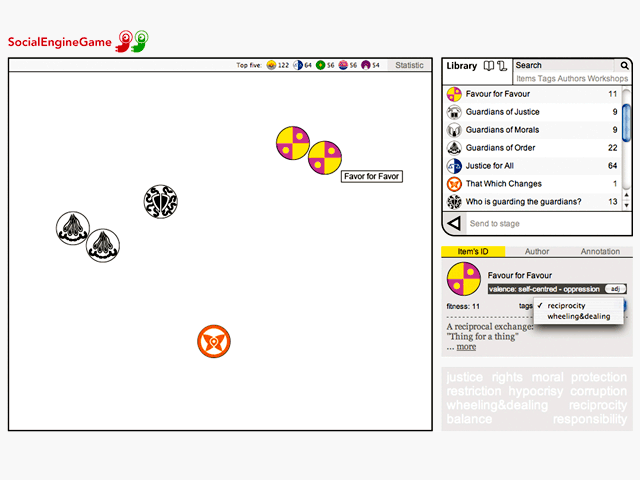
Aims to create social awareness about how information circulates within society, how it is accepted and transmitted further on, and in which way socio-cultural patterns shape the social system.
Urtica’s statement:
Social Engine explored how socio-cultural patterns spread and in what ways they shape the society we live in. Thus, the first version of the Social Engine was created as a database of well-known socio-cultural patterns embodied in textual and visual symbols. We surfed the Internet for the most quoted sayings, the main selection criterion being that they had been circulating for a long period of time.
Each symbolic representation of a socio-cultural pattern within the Social Engine database is sediment of meaning, actions, and context from the real world. It’s a result of an aggregation and integration of encoding discrepancies which have occurred in different time (or place) circumstances. For example, a pattern such as “general welfare for everyone” can evoke a variety of connotations, basically meaning that people should work for the common good, or else, as a side effect, it serves to justify the authority and oppressive action of the sovereign state. It also conjures up a broader social context since the implementation of the politics of welfare has a wide impact on the function and organization of society. “The politics of welfare” asserts that welfare raises concerns where it is seen to have implications for public order, as one politician wittily stated, “If you do not give the people social reform, they are going to give you revolution.” The pattern “general welfare” has been circulating within human society for a long time. It raises intellectual debate, but also brings to mind some everyday facts and thoughts. Some statistics claim that, on less than two dollars a day, almost half of the world’s population now lives below the poverty line. In that light, the joke “The war against poverty is over. The poor lost.” is not very far from reality.
Urtica, But First You Have To Trust, Social Engine – The Hybrid Source Book
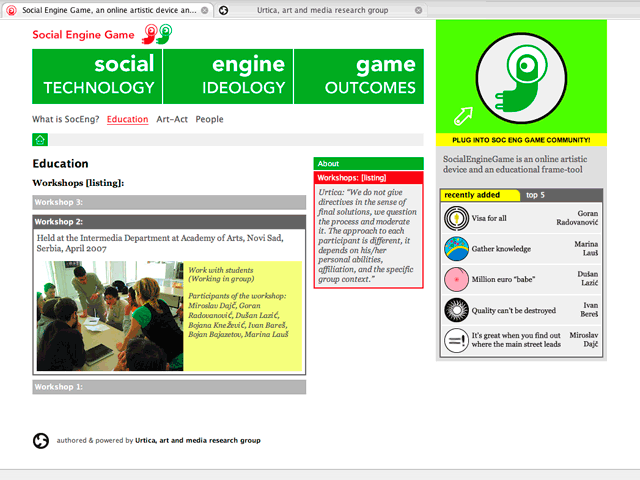
Begun in 2004 as an Internet based artwork, over time the Social Engine had five editions (screenshots of diferent versions are listed in a gallery above). Today it functions in the form of the HoopUp Collaborative Platform
Credits: Daniel Stevanović and Vladimir Kostić, Programming